
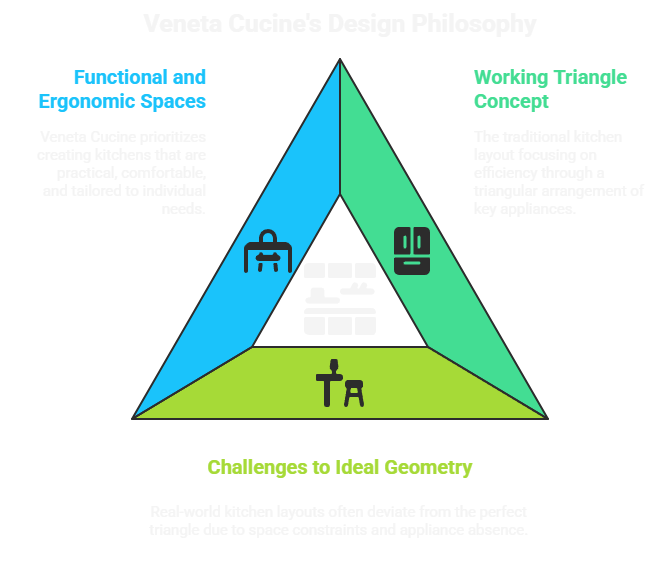
When it comes to kitchen design, many people immediately think of the classic “work triangle” — the cooktop, the sink, and the refrigerator forming a perfect triangle to maximize efficiency. While this guideline has helped generations of home cooks, real kitchens often present challenges that make a perfect triangle impossible. Narrow layouts, linear kitchens, or the absence of certain appliances can all disrupt the ideal geometry.
At Veneta Cucine, we believe that great kitchen design is about more than triangles. It’s about creating spaces that are functional, ergonomic, and tailored to the way you actually live. In other words, a kitchen should work for your daily routine, not just for a diagram.
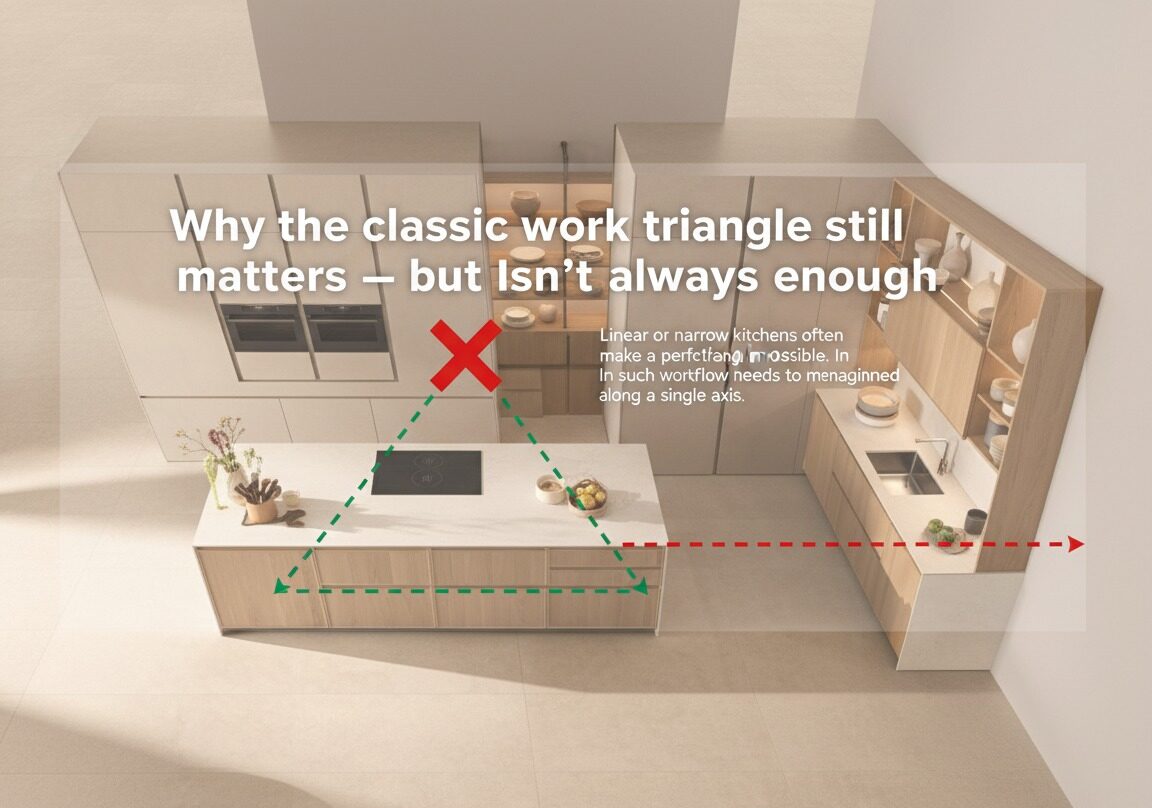
Why the classic work triangle still matters — but Isn’t always enough
The work triangle is designed to minimize walking between the three most used areas of the kitchen. When executed well, it ensures that everything you need is within easy reach.
However, the triangle has its limits:
- Linear or narrow kitchens often make a perfect triangle impossible. In such layouts, the workflow needs to be reimagined along a single axis.
- Countertop surfaces are often overlooked. The triangle assumes you have enough space beside each appliance to set down pans, trays, or groceries, but that isn’t always the case.
- Additional appliances or structural constraints like windows, columns, or kitchen islands can disrupt the triangle and force adjustments.
While the triangle is a helpful guideline, the true measure of a kitchen’s functionality is how well it supports your workflow.
When triangles don’t work: real-world constraints
In practical terms, many modern kitchens require flexibility beyond rigid geometric rules:
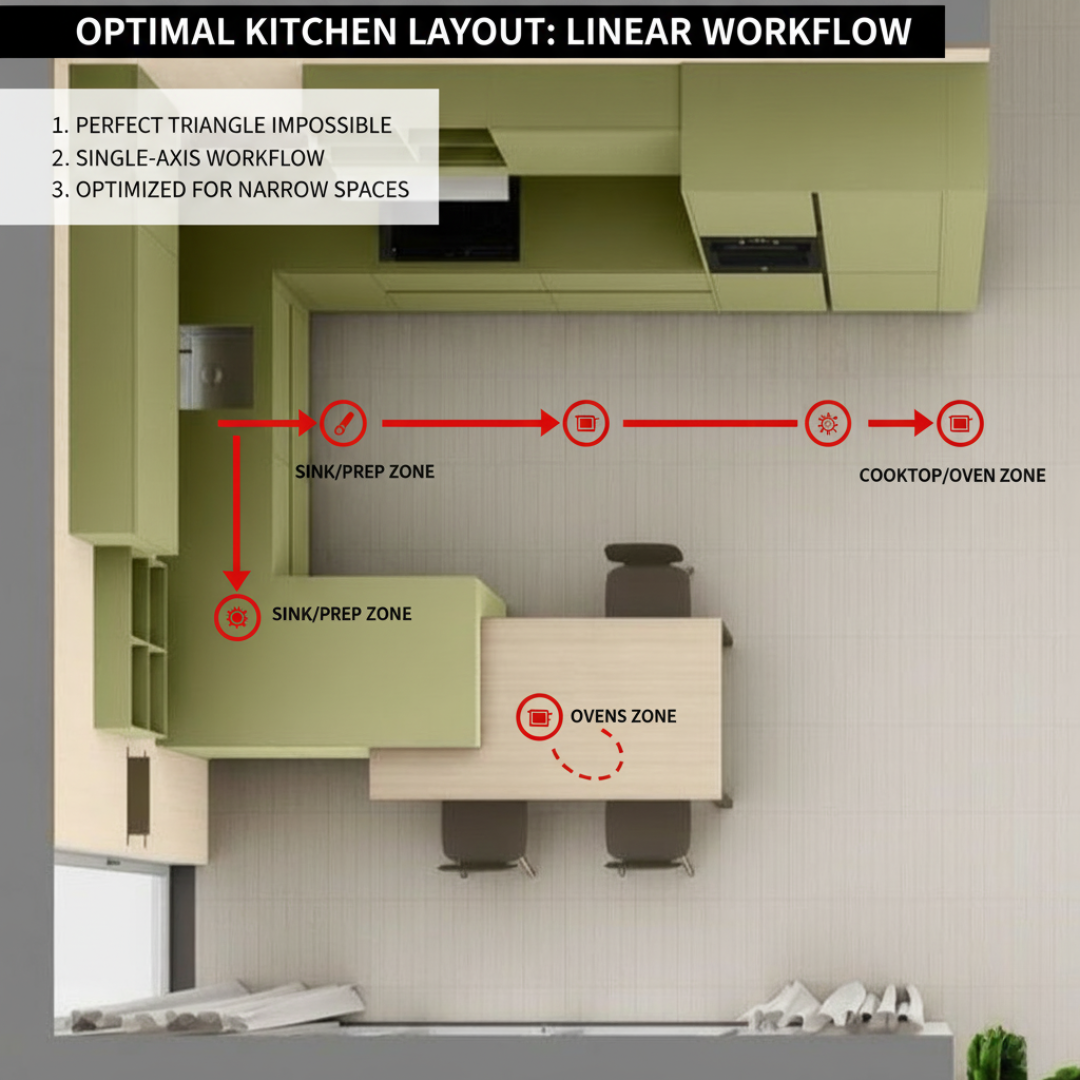
- Linear kitchens: When all appliances and work areas are on a single wall, the triangle concept isn’t possible. In these cases, it’s essential to plan distances between stations carefully, ensuring that each task area — prep, cooking, cleaning — is reachable without excessive movement.
- Narrow or long kitchens: In tight layouts, precision is key. Even a small miscalculation can make the kitchen feel cramped or inefficient. Planning exact distances ensures smooth movement.
- Kitchens without adjacent surfaces: Many kitchens lack built-in ovens with side counter space. Without a landing zone next to the oven, there’s nowhere to place hot trays safely. Countertop extensions or integrated prep surfaces become essential.
- Cooktop and sink too close together: If there’s insufficient space between them, you end up juggling items and cluttering your prep area. Proper spacing prevents accidents and makes cooking more enjoyable.
- Specialty zones: Modern kitchens often include areas for coffee, baking, or cleaning. These zones can break the triangle logic if they are not strategically placed.
Key spacing rules & distance guidelines
Here are detailed principles to optimize kitchen function, regardless of layout:
Landing zones / support surfaces
- Adjacent counter space for appliances: Always ensure there is at least a small surface beside your cooktop and oven for setting down pans, trays, or ingredients. Ideally, each side should have a landing area of at least 24 inches.
- Continuous counter between cooktop and sink: This area becomes your main prep zone, allowing easy movement between cooking and cleaning without juggling items midair.
- Flexible surfaces for small kitchens: Fold-out, slide-in, or pull-out surfaces can act as temporary landing zones when permanent counters aren’t possible.
Minimum clearances & walkways
- Aisle widths: Maintain at least 36 inches for single cooks and 42–48 inches if multiple people will work simultaneously. This prevents congestion and keeps traffic flowing.
- Obstruction-free paths: Avoid placing islands, tables, or tall cabinets in the way of primary zones. Every movement should feel natural and unobstructed.
- Appliance clearance: Make sure oven doors, refrigerator doors, and dishwasher panels can open fully without hitting walls, islands, or other appliances.
Maximum allowable gaps
- Distance between stations: Even if a perfect triangle isn’t feasible, major work areas should not be too far apart. Excessive distance forces unnecessary walking and interrupts workflow.
- Perimeter efficiency: The sum of walking distances between primary zones should feel natural and comfortable — neither too close to cause crowding nor too far to slow down tasks.
Functional adjacencies & priorities
- Cooktop positioning: Should always have counter space on at least one side, ideally both, for prep, plating, and cooling pans.
- Refrigerator proximity: Place near prep zones so ingredients are easily reachable while preparing meals.
- Sink placement: Centrally located to be accessible from both cooking and cleaning areas.
- Avoid obstruction: Tall cabinets, columns, or other structures should not block movement between critical zones.
Zoning approach over triangle
- Task-based zones: Think in terms of cooking, prep, cleaning, and storage, rather than strict geometric shapes.
- Buffer zones: Create small transition areas, such as a counter between the fridge and prep area, to prevent congestion.
- Sub-triangles: In large kitchens, break the space into mini-triangles for each workstation, such as baking, cooking, and cleaning zones.
Applying these principles with veneta cucine
Veneta Cucine’s modular kitchens are built to adapt to your life:
- Seamless surfaces: Keep counters clear and workflows smooth, even in compact layouts.
- Innovative materials: Durable, elegant surfaces allow easy cleaning and multitasking while maintaining a sophisticated aesthetic.
- Custom layouts: Linear, U-shaped, and peninsula kitchens are all optimized for landing zones, distances, and functional flow.
- Integrated solutions: Pull-out surfaces, hidden handles, and adjustable shelving provide extra flexibility where space is limited.
With careful planning, even kitchens that cannot accommodate a perfect triangle can be highly efficient and enjoyable to cook in.
Tips & best practices
- Map your workflow: Track how groceries, cooking, and cleaning move through your kitchen.
- Prototype with tape or mockups: Test distances and flow before committing to final layouts.
- Maximize countertop depth and continuity: Avoid isolated “islands” of unreachable space.
- Use flexible elements: Sliding shelves, pull-outs, and retractable surfaces help adapt to your workflow.
- Prioritize critical distances: Focus on key zones if your space is limited, such as cooktop-to-prep and fridge-to-prep.
- Consult professionals: Designers can reconcile constraints with ergonomic guidelines, ensuring your kitchen works beautifully.
Takeaway
The work triangle is a helpful starting point, but real kitchens demand more thoughtful planning. True functionality comes from careful spacing, landing zones, and task-based zones tailored to how you live.
At Veneta Cucine, we combine craftsmanship, innovation, and flexibility to create kitchens that are as practical as they are beautiful. Whether your layout is linear, U-shaped, or more complex, smart design ensures your kitchen works for you every day.